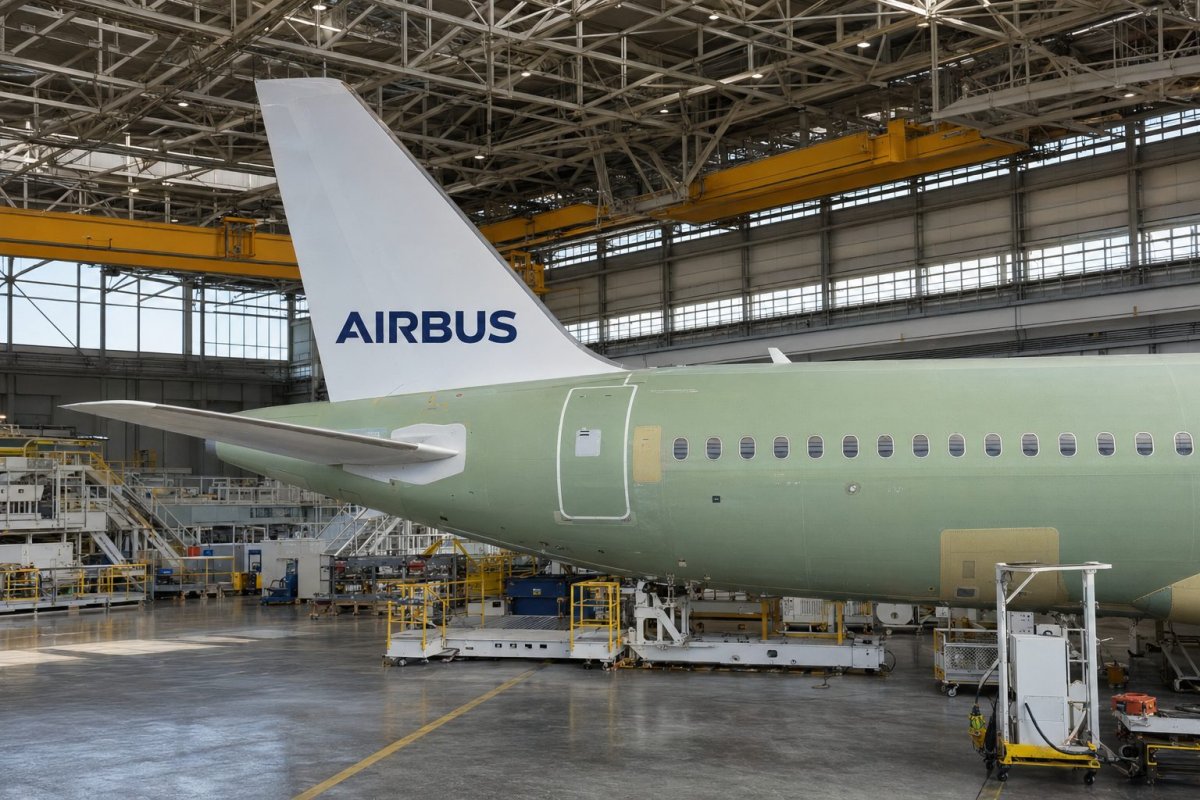
Airbus SE (EPA:AIR) saw its shares edge lower on Wednesday, closing at €208.05, a decline of 0.8%, as investors weighed the feasibility of the company's ambitious production targets for its best-selling A320 family. The market's skepticism stems from the significant acceleration required in the second half of the year to meet full-year delivery guidance.
The European aerospace giant handed over 351 commercial jets in the first half of 2026. To hit its annual target of approximately 870 deliveries, Airbus must now deliver 519 aircraft between July and December. This translates to an average monthly pace of 86.5 jets, a substantial leap from the 58.5 per month achieved in the first half—a 47.9% increase.
For the A320 family specifically, 271 aircraft were delivered in H1, averaging 45.2 per month. The company's stated goal of producing 70 to 75 A320-family jets monthly by the end of 2027 represents a 55% to 66% increase over that current delivery rate. While delivery numbers lag production due to timing, the gap underscores the scale of the challenge.
Investor attention is focused on the execution gap between today's output and the future ambition. The company maintains its formal objective of 70-75 jets per month by end-2027, a target that would require a significant boost in production efficiency across its ten final assembly lines spanning four nations.
Backlog Provides Buffer, But Risks Persist
Demand remains robust, with a total commercial aircraft backlog of 9,222 units as of June 30. The A320 family backlog alone stood at 7,499 aircraft by end-May, with the A321neo variant accounting for 5,615 of those orders—75% of the family total. This deep order book provides Airbus with pricing power but also amplifies the consequences of any production shortfall.
Chief Executive Guillaume Faury noted that "steady execution is paying off" after improved second-quarter deliveries. First-half revenue grew 12% to €33.2 billion, while adjusted EBIT rose 24% to €2.73 billion. However, free cash flow before customer financing remained negative at €1.17 billion, reflecting inventory build-up.
Supply Chain Constraints and Competitive Landscape
Engine shortages continue to be a major bottleneck for narrowbody production. Pratt & Whitney, a key engine supplier for the A320neo, has faced ongoing issues, and CEO Faury has previously cautioned that these constraints could keep production below the rate 75 target. This risk is compounded by potential delays in cabin equipment and ongoing quality inspections.
Boeing Co. (NYSE:BA) remains the closest competitor in the narrowbody segment, with plans to potentially produce around 70 737 aircraft per month, though its official target is 63. Airbus's competitive edge hinges on its ability to convert assembly resources into completed aircraft despite these supply chain headwinds.
Analyst Sentiment and Stock Performance
Despite the challenges, analyst consensus remains bullish. Barclays maintains a Buy rating with a €260 price target, implying a 25% upside from current levels. RBC Capital and Deutsche Bank also rate the stock a Buy, with targets of €250 and €232, respectively. The average target among 24 analysts stands at €229.74, suggesting a potential 10.4% gain.
However, the stock has already retreated 3.5% from Friday's close of €215.55, and sits 6.0% below its 52-week high of €221.30. The narrow margin to consensus targets leaves little room for further delays in production ramp-up.
Upcoming Catalysts and Risks
Investors will closely monitor two key developments in the coming week. First, suppliers must demonstrate their ability to manage an accelerated handover schedule, particularly for aircraft that have been parked awaiting components. Second, the first flight of the delayed A350F freighter is now scheduled for September, according to a Reuters report.
Additional risks include potential dollar weakness, which could reduce euro-denominated revenue, and the possibility that increased production speed could strain cash flow before customer payments are received. The fundamental question remains whether the ten assembly lines can achieve the necessary pace—a question that the second-half delivery bridge will help answer.