Amazon.com Inc. (NASDAQ: AMZN) experienced a 1.7% decline in premarket trading on Tuesday, with shares changing hands at $279.15, following a record close on Monday that pushed the e-commerce giant's market capitalization above $3 trillion for the first time. The dip comes on the heels of a Form 144 filing revealing that founder and Executive Chair Jeff Bezos intends to sell 15 million shares, a transaction valued at approximately $4.07 billion based on Monday's closing price.
While the dollar amount is substantial, the proposed sale represents only 0.14% of Amazon's outstanding shares, a relatively modest stake. Importantly, the trading plan was adopted in November 2025, well ahead of last week's blockbuster earnings report, indicating that the sale is pre-planned and not a reaction to recent developments. The filing is part of a Rule 10b5-1 plan that runs through February 2027, providing a structured framework for the disposition.
Despite the premarket pullback, the stock remains 18.5% above Thursday's pre-earnings close, suggesting that investors are still digesting the strong quarterly results. The market's focus is squarely on Amazon Web Services (AWS), which delivered a calculated incremental operating margin of 56.9% in the second quarter—meaning that for every additional dollar of revenue, AWS generated about 57 cents of extra operating income. This metric, while not officially reported by the company, underscores the immense profitability of the cloud division.
AWS's performance was nothing short of stellar. Revenue surged 36.8% year-over-year to $42.23 billion, while operating income jumped 63.6% to $16.62 billion. The unit's operating margin expanded by 6.5 percentage points to 39.4%, a clear sign of operating leverage. CEO Andy Jassy noted that "AWS is booming," as the unit posted its fastest growth in 18 quarters. This strength is critical, as AWS now accounts for 60.5% of Amazon's consolidated operating income, despite contributing only 21.1% of total sales.
The broader segment picture shows North America generating $116.18 billion in sales (57.9% of total) with an operating margin of 7.9%, while International contributed $42.20 billion (21.0%) with a thinner 4.1% margin. This concentration underscores the importance of AWS to Amazon's bottom line.
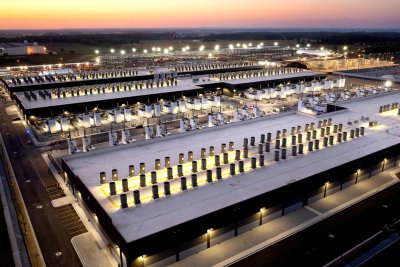
However, the cash flow narrative is less rosy. Trailing twelve-month property and equipment purchases soared 64% to $169.0 billion, outpacing operating cash flow growth of 33% to $161.4 billion. This led to negative free cash flow of $7.6 billion, a sharp swing from positive $18.2 billion a year ago. Management has lifted its 2026 capital expenditure forecast to $220 billion, about 71% above 2025 levels, and Jassy indicated that even this higher budget would not meet all current demand.
Investors should also note that reported earnings were flattered by a massive one-time gain. The $62.6 billion quarterly profit included $53.4 billion in pre-tax other income, primarily from Amazon's investment in Anthropic. This distorts the trailing price-to-earnings ratio of 22.8, making it a less reliable gauge of underlying profitability.
In the broader market context, cloud peers Microsoft (NASDAQ: MSFT) and Alphabet (NASDAQ: GOOGL) rallied 4% and 3.6% respectively on Monday, as investors rewarded companies with clear ties between infrastructure spending and cloud growth. Bill Birmingham of REX Financial framed the key test as "visible, near-term revenue and margin expansion," a bar Amazon cleared within AWS but not yet in free cash flow.
Looking ahead, Amazon guides third-quarter sales between $197 billion and $202 billion, with a midpoint of $199.5 billion—2.2% below consensus estimates. The operating income midpoint implies roughly 41% growth year-over-year. Risks remain, including memory, energy, and tariff costs that could inflate the buildout bill, as well as potential demand slowdowns that would leave $220 billion in spending against negative free cash flow. The Bezos filing adds a near-term supply overhang, but the larger test remains AWS's ability to sustain incremental margins near 57%, which would justify the massive capital expenditure plan. A sharp retreat would renew scrutiny of the company's spending strategy.