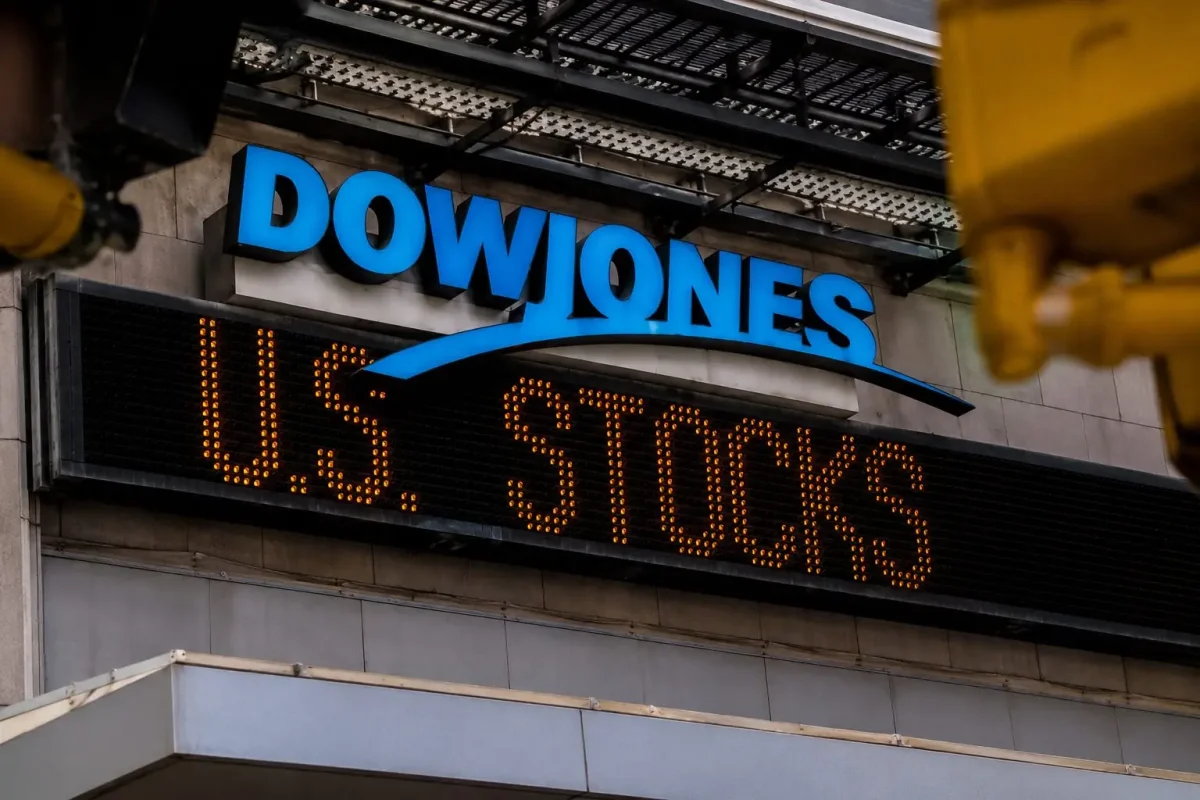
The Dow Jones Industrial Average closed at 52,685.92 on July 15, 2026, gaining 177.65 points, or 0.34%. However, a closer look reveals that the advance was heavily concentrated in just four technology giants, which together added approximately 250.8 points to the index, while the remaining 26 components collectively subtracted 73.1 points.
The S&P 500 rose 0.36% to 7,570.72, and the Nasdaq Composite climbed 0.60% to 26,264.63. The disparity in the Dow's performance stems from its price-weighted methodology, where a stock's dollar change, not its market capitalization, determines its impact. At the close, Apple, Alphabet, Microsoft, and Amazon accounted for about 15% of the index's price weight but contributed 141% of its net gain, based on closing prices and a divisor of 5.94 Dow points per $1 change in a stock.
The catalyst for the rally was a surprising drop in U.S. producer prices. The Producer Price Index fell 0.3% in June, against expectations of a modest increase. This prompted traders to reduce the implied probability of a quarter-point Federal Reserve rate hike in July to 10.2%, down sharply from 31.0% the previous week. Investors piled into rate-sensitive growth stocks, pushing the tech-heavy quartet higher.
Apple (NASDAQ:AAPL) was the largest contributor, adding approximately 75.1 points after its stock rose $12.64, or 4.01%, to $327.50. Alphabet Class A (NASDAQ:GOOGL) contributed about 67.8 points, gaining $11.41, or 3.17%, to $370.92. Microsoft (NASDAQ:MSFT) added 63.6 points, rising $10.70, or 2.78%, to $395.63. Amazon.com (NASDAQ:AMZN) contributed 44.4 points, advancing $7.47, or 3.02%, to $254.96. Together, these four stocks accounted for over 80% of the Dow's total gain.
Alphabet's impact is particularly notable, as it only joined the Dow on June 29, replacing a stock with roughly half a percentage point of index weight. In less than three weeks, Alphabet was responsible for an estimated 38% of the day's net gain. The concentrated rally underscores the Dow's structural quirks, where a handful of high-priced stocks can dominate performance.
The inflation data provided broad relief. Goods prices fell 1.4%, driven by a 6.4% decline in energy costs, while services prices edged up 0.2%. The core measure, excluding food, energy, and trade margins, rose just 0.1%. New York Fed President John Williams commented that there are "encouraging reasons to expect that inflation has peaked and should edge down in coming quarters," according to the Bureau of Labor Statistics.
Outside the Dow, market breadth was more positive. On the New York Stock Exchange, advancers outpaced decliners by a ratio of 1.48 to 1. Among the S&P 500's 11 sectors, communication-services names led the gains, suggesting that the heavy concentration in the Dow was more a reflection of its construction than a market-wide reliance on a few stocks.
However, the high concentration introduces risk. If all four stocks were to drop 1% simultaneously, they would erase about 80 Dow points based on Wednesday's closing prices. Rick Meckler at Cherry Lane Investments noted that "bad news doesn't seem to hurt the market," but warned that investors might be discounting geopolitical risks, such as tensions in the Middle East and rising oil prices, which have intensified since the June inflation data were released.
Investors are now watching to see if the rally broadens across the Dow or if the tech-heavy core continues to drive the index. For now, the 178-point advance reflects a narrow price move rather than widespread optimism across all 30 components.