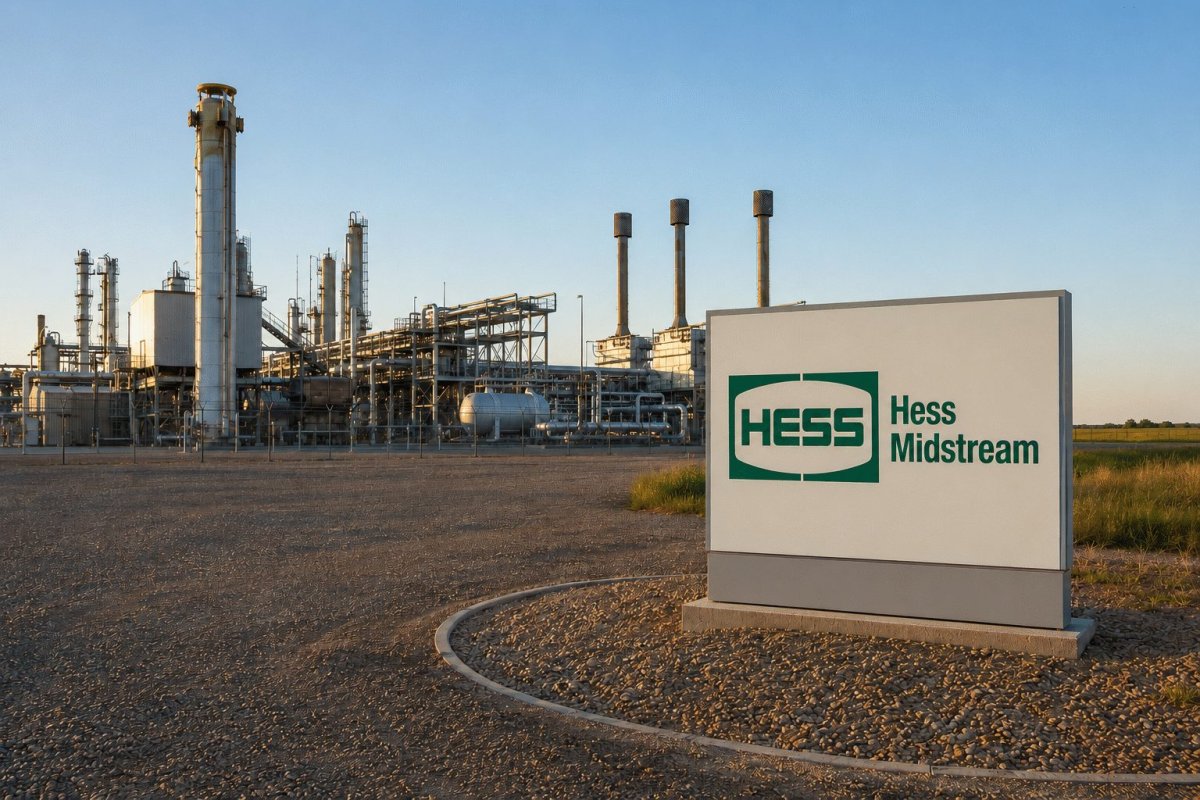
Hess Midstream LP (NYSE: HESM) closed the trading week on a soft note, with shares slipping 3.4% to $39.14. The decline came despite a modest uptick in the final session, underscoring a disconnect between the partnership's robust income profile and its muted valuation outlook.
The company's quarterly distribution of $0.7888 per unit, paid on August 14, translates to an annualized yield of approximately 8.1%. This payout is supported by stronger cash conversion, even as top-line revenue has contracted. In the second quarter, adjusted free cash flow surged 19.5% year-over-year to $231.6 million, while revenue fell 3.7% to $399.0 million. The divergence is largely attributable to a 56% reduction in capital expenditures, which dropped to $30.6 million following the completion of compression expansion projects.
Adjusted EBITDA remained nearly flat at $313.7 million, a decline of less than 1% from the prior-year period. Basic earnings per share edged up 1.4% to $0.75. Chief Executive Jonathan Stein emphasized the company's focus on generating adjusted free cash flow to support shareholder returns and balance sheet strength, a strategy that appears to be yielding results.
The board approved a $0.0096 increase in the quarterly distribution, aligning with the company's stated goal of 5% annual distribution growth through 2028. For the full year 2026, Hess Midstream guides to adjusted free cash flow in the range of $910 million to $960 million, with a midpoint of $935 million. Planned distributions are set at $655 million, leaving approximately $280 million in excess cash—about 43% of the intended payout. This implies a preliminary adjusted free-cash-flow coverage ratio of roughly 1.43 times at the midpoint.
Despite this cushion, Wall Street remains cautious. The average analyst target price stands at $37.50, which is 4.2% below Friday's closing level. The consensus includes two sell ratings and five holds, with targets ranging from $32 at Goldman Sachs to $40 at Wells Fargo. Analysts point to operational headwinds, including a 15% year-over-year decline in oil terminaling volumes, a 12% drop in water gathering, and a 4% slip in gas processing due to scheduled maintenance at the Tioga facility.
Chevron Corporation (NYSE: CVX) remains a pivotal customer, with affiliate services accounting for $379.8 million, or 95% of quarterly revenue. While third-party revenue more than doubled, it still represents a modest $17.9 million. This concentration underscores the risk if Bakken activity slows, which could pressure volumes and distribution coverage. Additionally, leverage and interest expenses could tighten cash flow available for distributions.
Investors will be watching whether HESM can hold its recent intraday low of $38.57 in the coming week. With no earnings report scheduled, the focus will remain on the partnership's attractive 8% cash yield, balanced against subdued volume momentum and limited analyst target revisions. The stock's current valuation suggests the market is pricing in minimal growth, even as the company continues to generate substantial free cash flow.