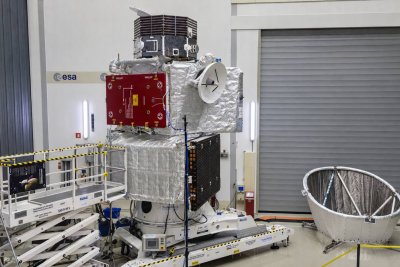
Warsaw, November 19, 2026 – Meridian Space has announced that its First Customer Link (FCL) satellite successfully established a high-bandwidth connection with the company's ground facility in Toulouse, France. The announcement, made on November 17, marks a significant step forward in the development of customer-owned broadband networks, a concept that could reshape how organizations deploy dedicated satellite communications.
The FCL satellite, launched in October, is a technology demonstrator designed to validate Meridian's proprietary communications payload. The Toulouse link represents the first in-orbit demonstration of the payload's ability to transmit data at high rates, though the company has not disclosed the specific speed achieved, the duration of the connection, or the measured latency. The design specification calls for downlink speeds of up to 1.1 gigabits per second (Gbps), but the company has yet to publish actual performance data.
Key Milestones and Data
According to Meridian's October 2 update, the satellite, built on Kongsberg NanoAvionics' MP42 platform, successfully powered on and responded to commands during its first ground-station pass. That initial contact confirmed the health of the satellite's subsystems, including Meridian's payload, but the high-bandwidth link was not yet established at that time. The November 17 announcement confirms that the payload has now achieved a link, though detailed performance metrics remain unpublished.
| Metric | Value |
|---|---|
| Design downlink speed | Up to 1.1 Gbps |
| Achieved rate | Not disclosed |
| Link duration | Not disclosed |
| Measured latency | Not disclosed |
| Ground endpoint | Toulouse, France |
Sources: FCL mission page and November 17 release. As of November 19, 2026.
Technology and Business Model
The core technology of the FCL satellite is an electronically reconfigurable reflectarray antenna. This advanced antenna can electronically adjust the direction and shape of its communication beams, offering a flexible approach to beam management. Meridian says this design reduces spacecraft mass and power requirements compared to traditional systems, though no quantitative comparisons have been provided.
Meridian's business model centers on owning satellite connectivity infrastructure, a departure from the traditional model of leasing capacity from large operators. The company plans to offer two services: Meridian Express, which aims to rapidly deploy dedicated networks for commercial and defense customers, and a larger constellation architecture for more extensive coverage. According to NanoAvionics, deliveries of Meridian Express satellites are expected to begin in 2027, though this is an expected timeline, not a guarantee of service availability.
Industry Context and Next Steps
The successful link to Toulouse is a critical validation of Meridian's technology, but it is only one step in a longer process. The company has outlined plans for further in-orbit tests of the antenna, payload operations, and ground infrastructure, as well as early customer trials. These trials will be essential to prove the system's reliability and performance under real-world conditions.
Via Satellite reported on the Toulouse link on November 16, citing an interview with Meridian's CEO. The interview highlighted planned demonstrations for governments, regional satellite operators, and telecommunications companies, covering both fixed and mobile applications. This second published account corroborates Meridian's claims, though the performance data still originates solely from the company.
The satellite communications market is increasingly competitive, with several players vying to offer high-throughput, low-latency services. Meridian's focus on customer-owned networks could differentiate it, but the company must demonstrate that its technology can deliver on its promises. Published throughput results and repeatable performance metrics will be essential to build credibility with potential customers and investors.
As of now, Meridian has not provided a timeline for when detailed performance data will be released. The company's next milestones include further testing and customer trials, which will likely be closely watched by industry analysts and potential partners.