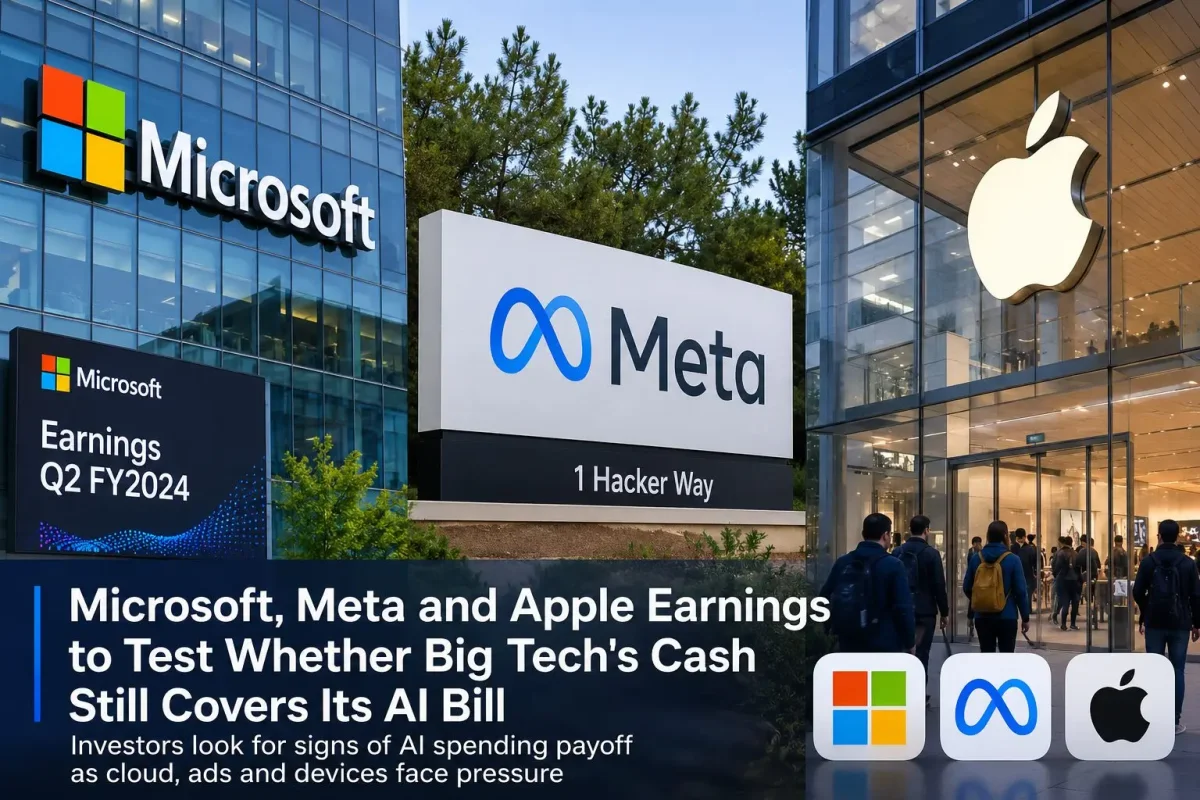
WARSAW, July 25, 2026 — As U.S. stock markets closed for the weekend, attention turns to a pivotal week for Big Tech earnings. Microsoft (NASDAQ:MSFT) and Meta Platforms (NASDAQ:META) are scheduled to report after the bell on Wednesday, July 29, followed by Apple (NASDAQ:AAPL) on Thursday, shortly after the Federal Reserve's rate decision. The results will be scrutinized for signs that these giants can sustain their soaring capital expenditures on artificial intelligence infrastructure.
The stakes were raised last week when Alphabet (NASDAQ:GOOGL) reported better-than-expected revenue growth of 24% but saw its shares plunge 7.1% — the steepest drop since May 2025. The culprit was not growth but cash. Alphabet's capital expenditure for the quarter exceeded its operating cash flow, resulting in negative free cash flow of $5.9 billion, an unusual position for a company known for consistent cash generation. Quarterly capex hit $44.9 billion, doubling year-over-year and setting a new high. This has shifted investor focus from the scale of investment to the strength of cash flows supporting it.
Overall, the four largest cloud companies — Microsoft, Alphabet, Amazon (NASDAQ:AMZN), and Meta — are now expected to spend nearly $725 billion in 2026 at the midpoint of their guidance, according to calculations based on recent outlooks. Microsoft forecasts around $190 billion, Alphabet between $195 billion and $205 billion, Amazon approximately $200 billion, and Meta $125 billion to $145 billion. This represents a more than 50% increase in consensus estimates over the past six months.
The market has reacted with caution. Last Thursday, the Magnificent Seven collectively lost nearly $800 billion in market capitalization. The S&P 500 closed Friday at 7,411.98, down 0.6% for the week, while the Nasdaq Composite ended at 24,975.82, a 2.1% decline. The Nasdaq 100 posted consecutive weekly losses for the first time since late March. The trade has become divided: the Roundhill Magnificent Seven ETF fell over 5% for the week, while semiconductor ETFs gained, as investors penalize the spenders and reward their suppliers.
Microsoft: Balancing Growth and Costs
Microsoft is set to report fiscal fourth-quarter results on Wednesday, along with its first fiscal 2027 forecast. Analysts polled by Refinitiv expect earnings of $4.24 per share, up 16.2%, on revenue of $87.67 billion, a 14.7% gain. The company previously projected over $40 billion in capital expenditures for the June quarter, equating to roughly 46 cents spent on infrastructure for every dollar of forecast revenue. About $25 billion of the annual capital plan is tied to higher component prices, and last quarter's gross margin was the tightest since 2022 due to increased data-center depreciation costs.
Bulls point to Azure's 40% growth and $627 billion in commercial remaining performance obligations. CFO Amy Hood stated in April that the company remains confident in the return on these investments. However, shares are trading around $390, down 22% over the past year despite four consecutive earnings beats. Oppenheimer analyst Brian Schwartz maintains an Outperform rating with a $515 price target but notes that skepticism around capex returns and perceptions that Microsoft is playing catch-up in AI are unlikely to be resolved with a single earnings report.
Meta: Doubling Down on AI Spending
Meta reports the same evening. Analysts expect earnings of $7.19 per share on revenue of approximately $60.3 billion, within the company's own forecast of $58 billion to $61 billion. Capital spending remains a key focus: first-quarter capex totaled $19.84 billion, below estimates, but full-year guidance of $125 billion to $145 billion implies quarterly spending of around $35 billion to $42 billion for the remainder of the year — roughly double the first-quarter level. The midpoint would nearly double the 2025 budget of $72.2 billion.
Meta shareholders are familiar with this pattern. In the previous quarter, the company posted 33% revenue growth, its fastest since 2021, yet the stock still fell about 7% in after-hours trading. Shares are trading near $650 ahead of the report.
Apple: A Different Approach
Apple provides a contrast. Analysts project fiscal third-quarter earnings of $1.89 per share, a 20.4% increase, on revenue of $108.89 billion, up 15.8%. Shares have gained 20.1% year-to-date as of July 23, and earlier this month, Apple briefly overtook Nvidia (NASDAQ:NVDA) as the world's largest company by market capitalization. The stock rose 3.5% on Friday, supporting the Dow. Unlike its peers, Apple is not investing in its own large-scale data-center infrastructure. Morgan Stanley analyst Erik Woodring stated that Apple's fundamentals remain very solid, but noted that a stock trading at all-time highs must avoid any setbacks; he raised his price target to $364. Rising costs for memory and storage are raising margin concerns.