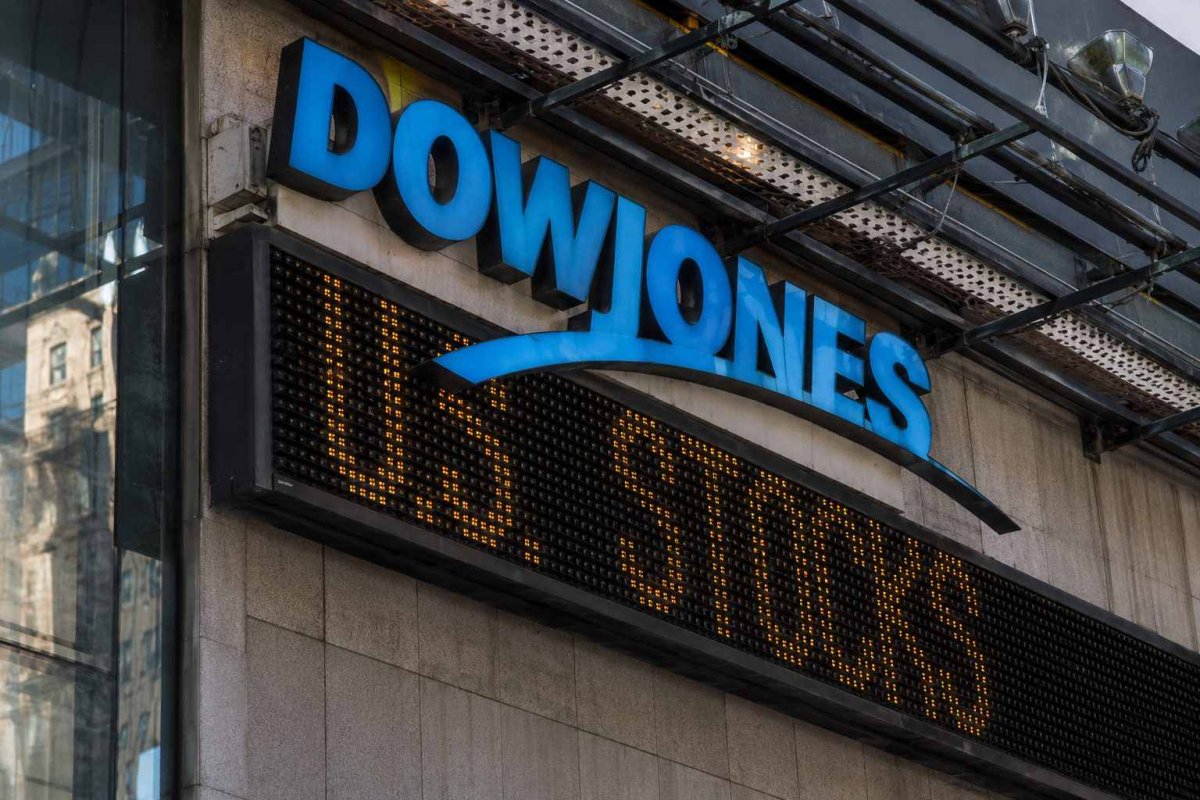
The Dow Jones Industrial Average struggled for direction on Friday, closing the morning nearly flat near the 52,000 mark, as investors digested a shift in the index's composition and mixed economic data. The price-weighted average gained 13.89 points, or 0.03%, to 51,934.51 by late morning trading, after swinging between 51,614.74 and 52,030.50 earlier in the session. The S&P 500 remained unchanged, while the Nasdaq Composite slipped 0.16%, according to Wall Street Journal market data.
Alphabet Inc. (NASDAQ:GOOGL) is set to join the Dow on Monday, replacing Verizon Communications Inc. (NYSE:VZ) effective before the opening bell on June 29. The change, announced by S&P Dow Jones Indices, a unit of S&P Global Inc. (NYSE:SPGI), will increase the index's exposure to high-priced technology stocks. Verizon's low share price had given it a minimal weighting of just 0.5% in the price-weighted Dow, prompting the adjustment. The index provider will modify the divisor to prevent any mechanical disruption to the index at the open.
Market Movers and Sector Performance
Early pressure came from Goldman Sachs Group Inc. (NYSE:GS) and Caterpillar Inc. (NYSE:CAT), which dragged the Dow down by as much as 303 points at 9:45 a.m. EDT, according to MarketWatch. In a price-weighted index, higher-priced stocks like these can disproportionately influence the average, even if their market capitalizations are not as large. Technology shares faced renewed headwinds, with Micron Technology Inc. (NASDAQ:MU) falling 6.2% after surging over 15% the previous day. Advanced Micro Devices Inc. (NASDAQ:AMD) and Nvidia Corp. (NASDAQ:NVDA) also traded lower. Apple Inc. (NASDAQ:AAPL) slipped following Thursday's 6.1% decline, which came amid reports of higher iPad and MacBook prices. Peter Cardillo, chief market economist at Spartan Capital Securities, attributed the tech pressure to expectations of "higher interest rates down the road." At B. Riley Wealth, chief market strategist Art Hogan described the memory market as facing a "comparable supply shock."
Consumer Sentiment and Inflation Data
Markets found some support from better-than-expected consumer sentiment data. The University of Michigan's final June sentiment index rose to 49.5, up from 44.8 in May, with consumer expectations increasing 15% month-over-month. However, survey director Joanne Hsu noted that "high prices are weighing down" household finances. One-year inflation expectations edged down to 4.6% from 4.8% previously. The Bureau of Economic Analysis reported that the Personal Consumption Expenditures (PCE) price index rose 4.1% year-over-year in May, with core PCE increasing 3.4%. Personal income, disposable income, and consumer spending all climbed 0.7%, while the saving rate held steady at 3.0%.
Interest Rate Outlook
Interest rates remained unchanged following the data, with most economists in a Reuters poll expecting the Federal Reserve to keep rates at 3.50% to 3.75% through the end of the year. Josh Hirt, senior U.S. economist at Vanguard, said that "holding rather than hiking" is the appropriate policy for now. Stephen Juneau, an economist at Bank of America Corp. (NYSE:BAC), described the Fed's June signals as "a materially hawkish surprise." The Dow's composition change underscores a broader shift toward mega-cap technology names, with Mark Malek, chief investment officer at Siebert Financial Corp. (NASDAQ:SIEB), calling Alphabet's inclusion a "blue-chip endorsement" of its artificial intelligence push, as reported by Axios.