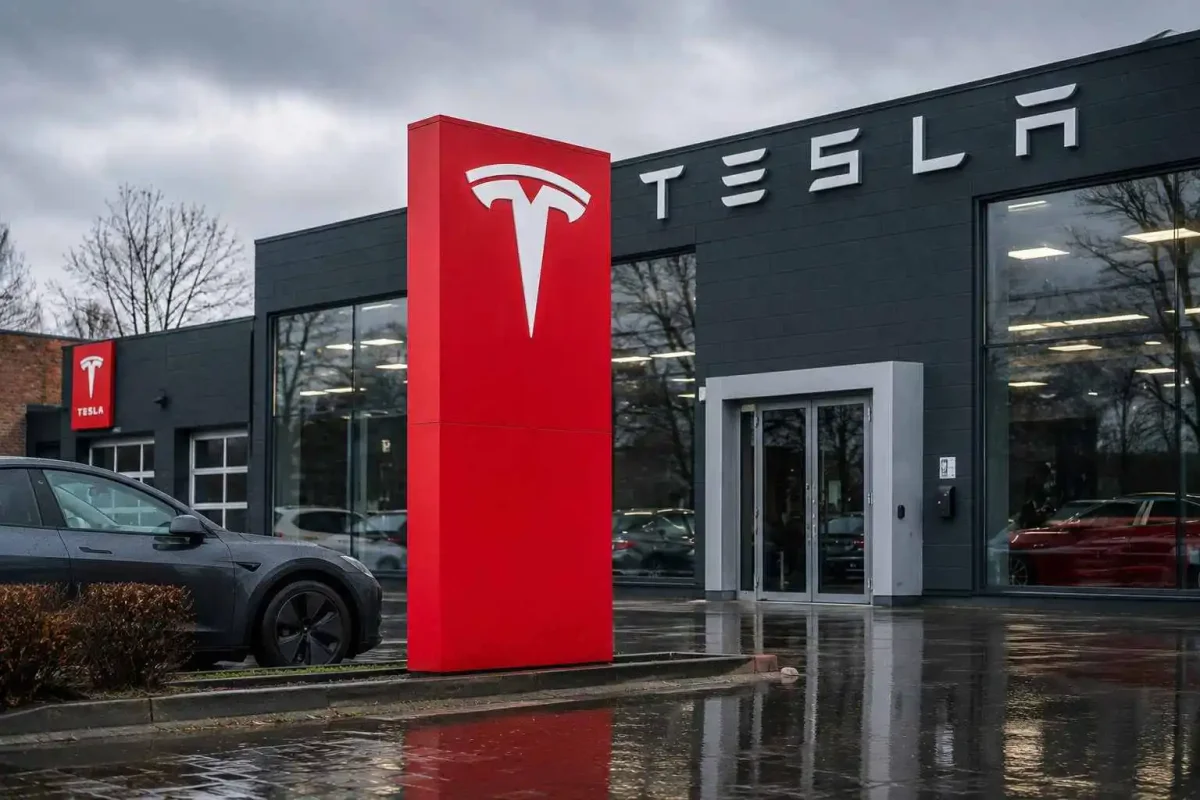
NEW YORK, July 25, 2026 — Tesla (NASDAQ:TSLA) shares tumbled 17.8% last week, closing at $313.03 on Friday, its lowest price in nearly a year. The sharp decline came as investors shifted focus from strong vehicle demand to the company's mounting capital expenditure needs and deteriorating cash flow metrics.
The Nasdaq Composite fell 2.1% over the same period, meaning Tesla underperformed the index by 15.7 percentage points. Selling pressure intensified after the automaker's second-quarter earnings release on Wednesday, with shares dropping 14.5% on Thursday alone and another 2.1% on Friday. Trading volume on Thursday surged to 3.8 times the level seen on Wednesday, underscoring the market's reaction.
Capital Spending Surge Raises Red Flags
Tesla used $8.28 billion in capital expenditures during the first half of 2026 and maintains a full-year outlook exceeding $25 billion. This implies over $16.72 billion in spending is needed in the second half, or more than $8.36 billion per quarter — 44% higher than the second-quarter record of $5.79 billion. These figures, based on early run-rate estimates, are not official company projections.
The required six-month expenditure represents 38% of Tesla's liquidity at the end of the quarter. As of June 30, the company reported $43.52 billion in cash and short-term investments. While some of the spending could be offset by operating cash inflows, the gap in cash conversion widened significantly.
Quarterly Metrics Reveal Pressure
Revenue rose 26% year-over-year to $28.24 billion, while vehicle deliveries increased 25% to 480,126 — both records. However, adjusted earnings per share came in at 33 cents, missing the LSEG estimate of 51 cents. Automotive gross margin slipped to 16.3%, below Visible Alpha's forecast of 18.04%.
Capital expenditure as a percentage of revenue jumped to 20.5% from 10.6% a year earlier. Free cash flow turned negative at $1.09 billion, compared to positive $0.15 billion in the year-ago period. Operating cash flow did increase 85%, but capital outlays grew at an even faster pace.
The average revenue per vehicle delivered fell to $42,730 from $45,345, reflecting the impact of price reductions. Income from regulatory credits declined 67% to $146 million, while research and development spending rose 49% to $2.37 billion.
Robotaxi Progress Lags Waymo
Tesla disclosed 2.5 million paid passenger miles from its robotaxi service, with 380,000 of those occurring without an in-vehicle safety monitor. For comparison, Alphabet's (NASDAQ:GOOGL) Waymo had completed over 220 million autonomous miles as of March. The figures cover different timeframes and use separate criteria, but the disparity highlights the early stage of Tesla's autonomous driving push.
On the positive side, active FSD Supervised subscriptions grew 56% to 1.48 million. Energy storage deployments rose 41% to 13.5 gigawatt-hours, and services and other revenue advanced 50%. These businesses offer paths to higher-margin, recurring revenue, though the operating margin of 1.4% indicates the transition remains costly.
CEO Calls 2026 'Massive Capex Year'
Elon Musk described 2026 as "a massive capex year" during the earnings call. Ryan Lee, senior vice president at Direxion, noted: "Monetization remains the central concern following the earnings miss."
Looking ahead, the Federal Reserve will meet on Tuesday and Wednesday, with preliminary second-quarter GDP figures and June inflation data due Thursday. Tesla has warned that rising interest rates could make vehicle financing less affordable, adding another layer of risk.
Risks to the outlook include faster-than-expected adoption of FSD, increased robotaxi deployment, or stronger service demand, which could boost cash flow earlier. Conversely, setbacks, softer vehicle pricing, or higher borrowing costs might prolong periods of negative free cash flow.
As markets open Monday, Tesla faces scrutiny not just on demand but on whether its heavy investment in autonomous technology can translate into sustainable profits.